Case study · draft
A student project from the Rethinking.Logistics studio showing how tools deliver metrics for decisions.
| Student | Ece Yasar |
| Project | Rethinking Logistics – Walther cross-dock, Kitzingen (green roof bridge / wildlife corridor) |
| Portfolio | heyzine.com/flip-book/f5cce4a20c.html |
| Studio | AD2 |
| Year | 2026 |
| Location | Walther cross-dock facility, Kitzingen (Bavaria), Germany – on the Würzburg corridor, between two forest patches |
| Typology | cross-dock warehouse (retrofit) |
| Status | draft |
Project
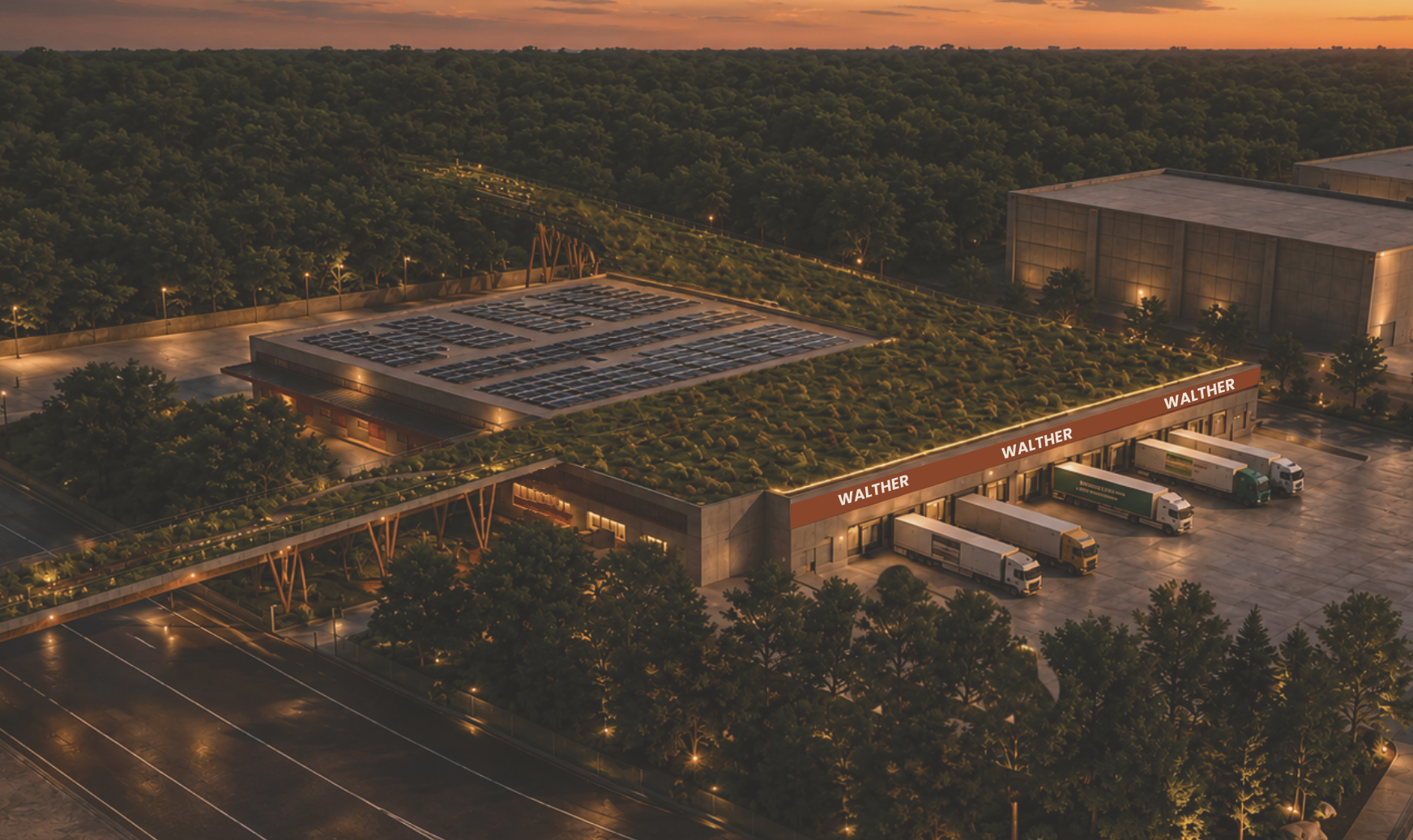
The project takes an existing small cross-dock facility in Kitzingen that sits between two forest patches separated by two major roads, leaving wildlife movement blocked at ground level and the warehouse roof as unused concrete. Instead of demolition, the roof is reinterpreted as an ecological platform: a planted bridge rises gradually from one forest edge, crosses the roads at roof height (7.0 m), continues as a native green roof over about half the roof area, and descends to the forest on the other side. The existing PV panels are retained alongside the green roof, and the bridge also provides shaded space for employees and a public landscape route for the nearby residential neighbourhood. An LCA of the existing building (One Click LCA, A1–A5) was used to show that concrete, HVAC and plastic membranes dominate the footprint.
How the student framed the challenge
- Habitat fragmentation by logistics roads
- Unused flat warehouse roofs
- Stormwater runoff from impermeable roofs
- Hard edge between logistics and community
Metrics and evidence
Every metric the project used, as named by the student, with the value, the calculation and the portfolio page.
| Metric | Student’s wording | Value | How it was calculated | Tool | Page |
|---|---|---|---|---|---|
| Green roof coverage | Green Roof | Existing 0% (full concrete slab) → proposal 50% of roof platform planted natively | Planted roof area divided by total roof platform area. | manual / formula | 13, 15 |
| Ecological connectivity | Wildlife corridor | Existing: building is a complete barrier → proposal: reconnected across two forest patches via green bridge at 7.0 m | Whether a continuous vegetated route links the two forest patches across the road barrier; assessed by site mapping. | manual / formula | 13, 14 |
| Biodiversity stress from materials | Biodiversity stress (LCA) | Existing: 7,920 PDF/m²/yr from materials → proposal: ‘partially offset by habitat creation’ (not quantified) | Indirect ecological impact of the building materials through the supply chain, computed with a biodiversity stress module run in parallel to the LCA. | One Click LCA (Biodiversity Stress tool) | 4, 13 |
| Embodied carbon intensity | LCA – Global warming | No total reported; bubble charts show concrete, HVAC components and plastic membranes as the largest contributors | Life cycle assessment of the existing Walther cross-dock across construction stages A1–A5, broken down by resource type and subtype. | One Click LCA | 4 |
| Stormwater runoff reduction | Stormwater absorption | Existing 0% (all runoff to drainage) → proposal ‘significantly reduced’ runoff (not quantified) | Share of roof rainfall retained by soil and filter layers instead of going to drainage. | not stated | 13, 15 |
| Stormwater retention volume | Roof water retention | Existing none (impermeable concrete) → proposal retained by growing medium | Presence of a growing medium able to retain rainwater on the roof. | not stated | 13 |
| Carbon sequestration by planting | Carbon sequestration | Existing 15% (some vegetation on site) → proposal ‘active via native roof planting’ (not quantified) | Vegetated area of site as a proxy for carbon sequestration potential. | not stated | 13 |
| Urban heat island effect | Roof heat island effect | Existing high (concrete absorbs full solar gain) → proposal reduced (vegetation cools surface) | Qualitative assessment of solar heat absorbed by the roof surface material. | not stated | 13 |
| Native species richness | Biodiversity on site | Existing none → proposal native flora and fauna habitat created | Presence of habitat and native flora/fauna on site. | not stated | 13 |
| Ecological connectivity | Ecological land use | Existing dead surface → proposal active habitat and movement corridor | Whether built surfaces contribute ecological function (habitat, movement). | not stated | 13 |
| Sun exposure of outdoor space | Shaded outdoor space | Existing none → proposal natural canopy under the green bridge | Availability of shaded outdoor space for staff. | not stated | 13 |
| Visual impact on neighbours | Visual impact | Existing no softening → proposal softened by green edges and planting | Qualitative assessment of how the building edge is softened by planting. | not stated | 13, 15 |
| Social acceptance | Connection to community | Existing no public or social value → proposal green bridge accessible as public landscape | Whether the site offers publicly accessible space or social value. | not stated | 13 |
| On-site renewable energy share | Solar panels | Existing present → proposal retained and integrated with green roof | Presence and retention of rooftop PV. | not stated | 13 |
| Energy use intensity | Building energy load | Existing uninsulated roof increases cooling demand → proposal reduced via thermal insulation layer (not quantified) | Qualitative effect of roof insulation and vegetation on cooling demand. | not stated | 13 |
Tools
- One Click LCA — LCA of the existing Walther cross-dock (A1–A5, EN 15804) with global warming bubble charts by resource type, plus the Biodiversity Stress tool for supply-chain ecological impact
Trade-offs
- Improved truck flow and dock capacity (logistics efficiency) reduces permeable area (stormwater), which the student proposes to mitigate with added green infrastructure (questionnaire).
- Material biodiversity stress from the building (7,920 PDF/m²/yr) is set against on-site habitat creation, but the offset is only claimed qualitatively.
Decision
The KPI comparison (0% green roof, no wildlife connection, all roof runoff to drainage) supported turning the existing roof into a planted platform and extending it as a green bridge across the roads to reconnect the two forest patches, while keeping the existing PV and the building itself (no demolition).
Open questions
- Most KPIs are reported qualitatively; only green roof coverage, existing vegetated share and LCA biodiversity stress have numbers.
- Stormwater reduction, carbon sequestration and energy load of the proposal are not quantified.
- Electricity price for the location and CapEx/OpEx split were not known (questionnaire).
- Student reports needing a deeper understanding of the KPI evidence base, and did not account for cost of transporting materials / sourcing local materials (questionnaire 4.4, 6.2).
Connections
- Challenges addressed: Biodiversity and ecological connectivity on logistics sites, Stormwater and sealed surfaces on logistics sites, Visual impact and acceptance by neighbours
- Metrics used: Green roof coverage, Ecological connectivity, Biodiversity stress from materials, Embodied carbon intensity, Stormwater runoff reduction, Stormwater retention volume, Carbon sequestration by planting, Urban heat island effect, Native species richness, Sun exposure of outdoor space, Visual impact on neighbours, Social acceptance, On-site renewable energy share, Energy use intensity, Green-core anchoring of mixed uses, Function stacking index
- Tools used: One Click LCA
Something wrong or missing? Suggest a correction