Domain · published
One of five thematic domains the studio worked in, synthesised from its student projects.
| Number | 5 |
| Group | Data Centers |
| Summary | A data centre is designed as an energy actor in its neighbourhood: its waste heat warms homes, greenhouses and public buildings, its roof produces power, and its siting follows the heat network and the grid rather than cheap land. |
| Status | published |
Also known as: Domain 5 · Strategy 5
Principle
A data centre is the newest kind of logistics building: it stores data instead of goods and turns almost all of its electricity into heat. Instead of exiling it to cheap land and cooling that heat away, the approach plugs it into its surroundings — waste heat goes to heat networks, greenhouses and neighbours, the roof produces power for the site and the grid, and the location is chosen where that exchange is possible.
Why it matters
Data centres are growing faster than the grids and cities around them. In the comparison used in the studio, an average conventional data centre consumes as much energy as roughly 20,000 households and a hyperscale one about 100,000 (From 20,000 households to a country). Cooling takes energy and, where traditional methods persist, large amounts of water (Waste heat and cooling of data centres, Nobody agrees how much water they use). In Czechia, power is already the limiting factor for where such facilities can go (Hyperscale data centres skip Czechia for lack of power), and the energy a building consumes and produces on site is a design question in its own right (Operational energy and on-site renewables).
Yet most data centres already sit in or near cities (Most of them are already urban), beside homes that need heat and neighbours who see blank boxes (Visual impact and acceptance by neighbours, Urban integration of logistics buildings). The studio asked whether this proximity can become an exchange rather than a conflict.
Projects
Three student projects treat the data centre as part of a local energy system, at three very different scales.
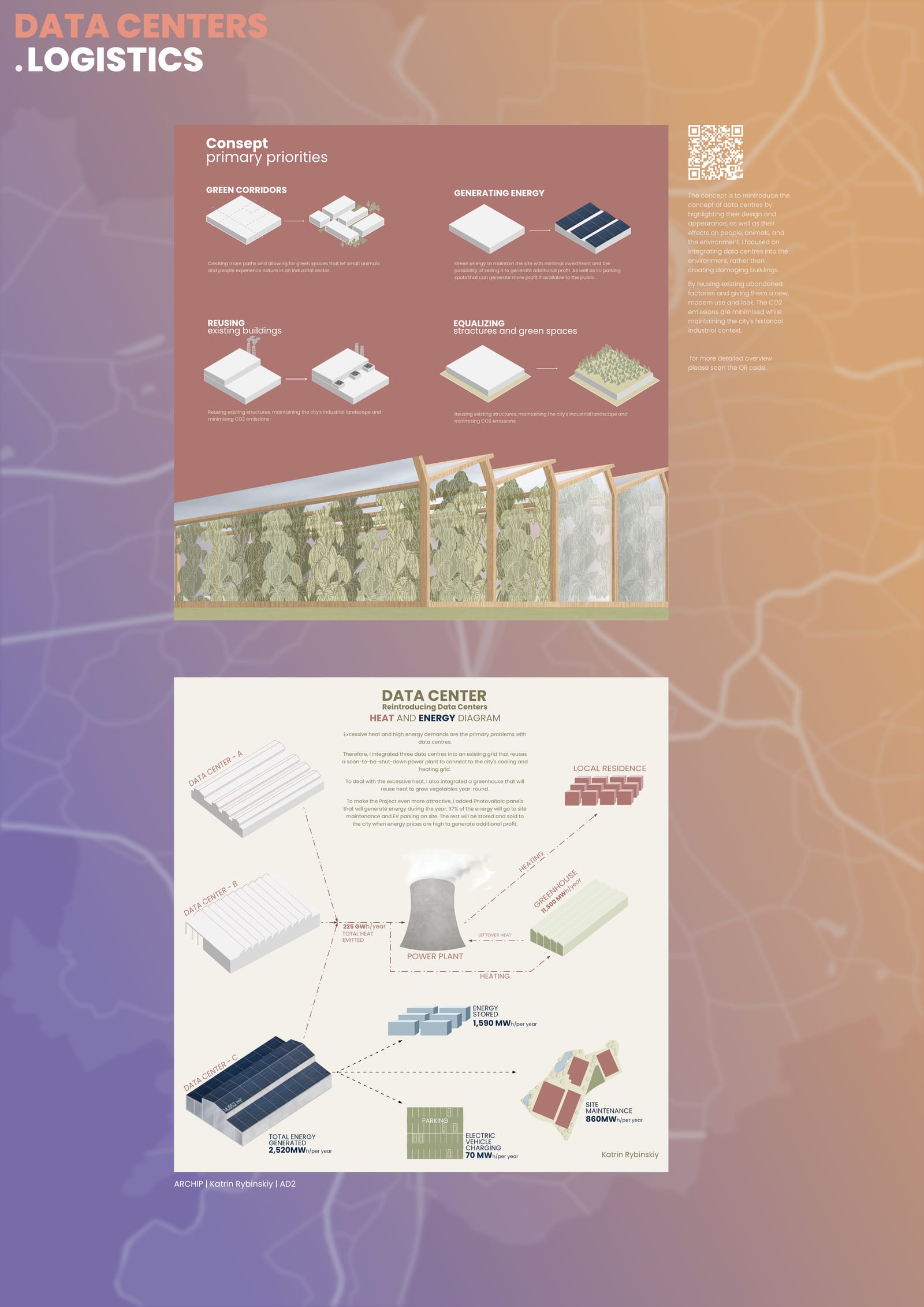
- Katrin Rybinskiy keeps two 1950s factory halls in Kladno’s former steelworks area as data centres, adds a third one with a fully PV-covered roof and a greenhouse, and routes the remaining waste heat through the nearby power plant to housing; paving gives way to ponds, trees and green corridors.
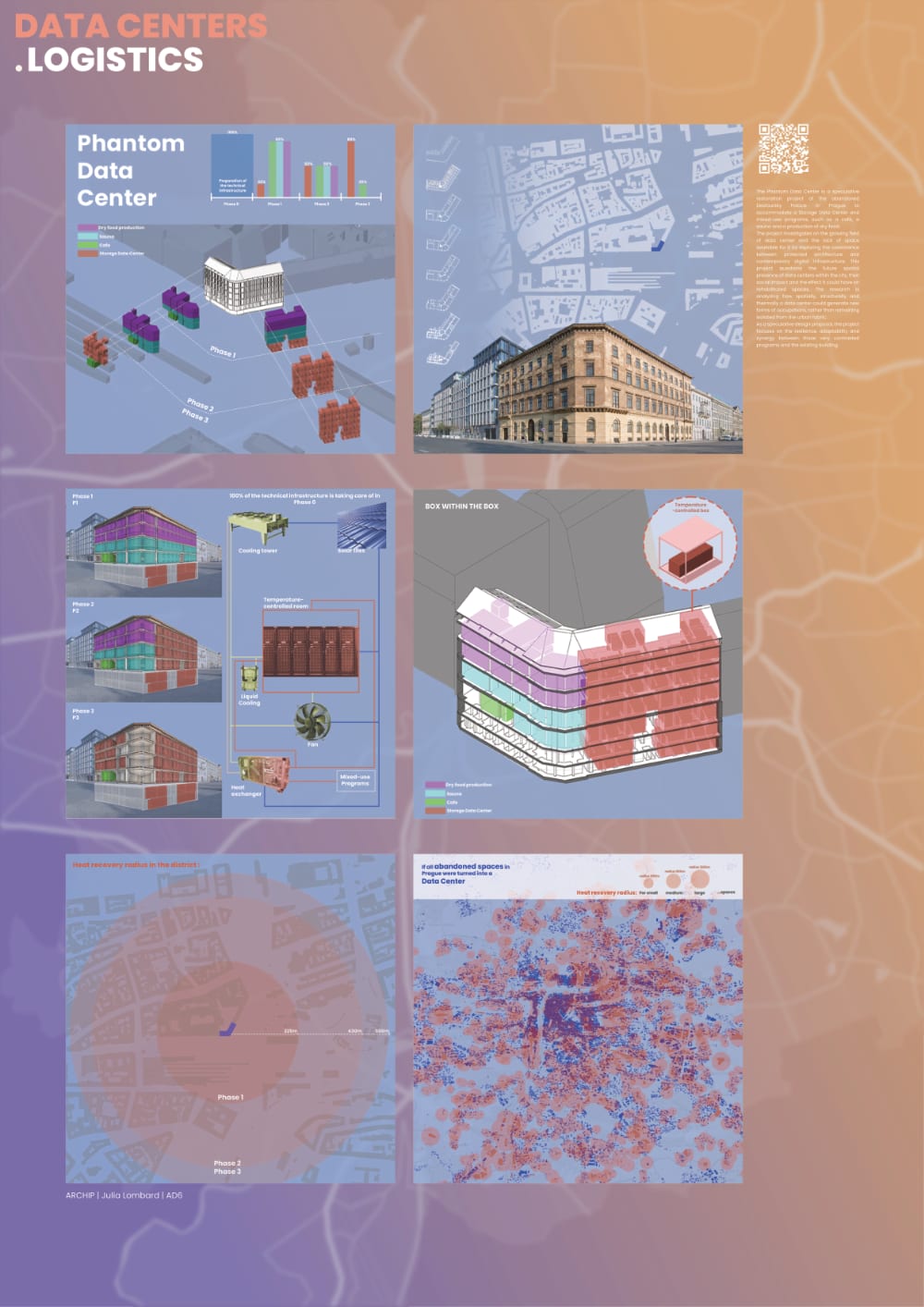
- Julia Godard Lombard inserts a storage data centre into the listed, long-neglected Desfourský Palace near Masarykovo station in Prague and pairs it with heat-hungry programmes — sauna and wellness, dry-food production, a café — in three phases with a growing data-centre share of 20%, 50% and 80%, exporting surplus heat to neighbours in later phases.
- Robin Jesenský designs HALECS, a row of modular server halls on the windy coast near Grindavík, Iceland, whose copper shells and cooling fins channel ground wind through the servers, with a closed water loop that could supply heat for residential hot water. The group sheet below also shows two projects of other strategies.
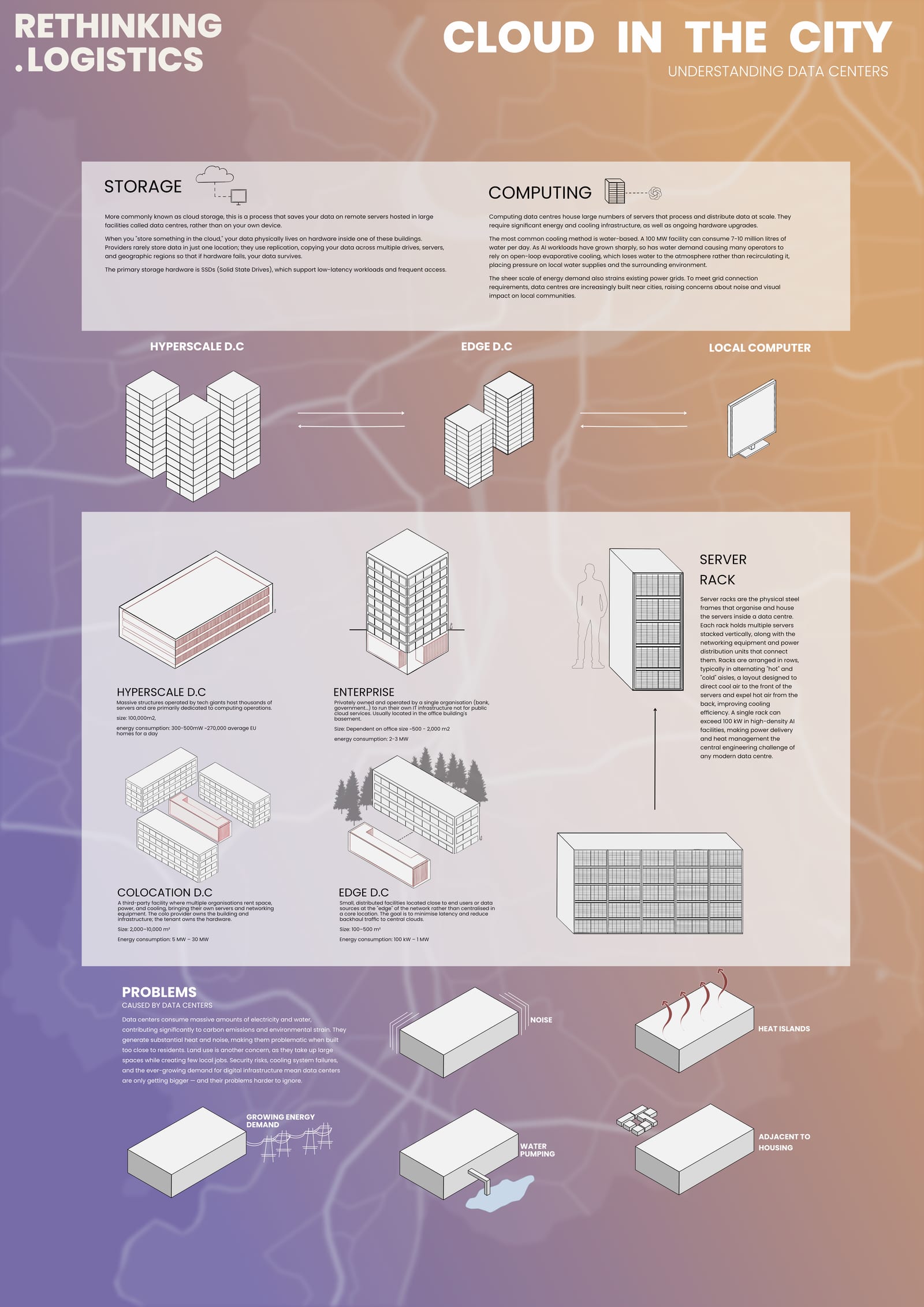
The exhibition also showed Cloud in the City – Understanding Data Centers, an explanatory poster without a student author. It presents the counter-scenario this domain responds to: data centres as energy-, water- and land-hungry neighbours that strain the grid, pump water, create heat islands and noise, and sit next to housing while offering few local jobs — what happens when they are not integrated.
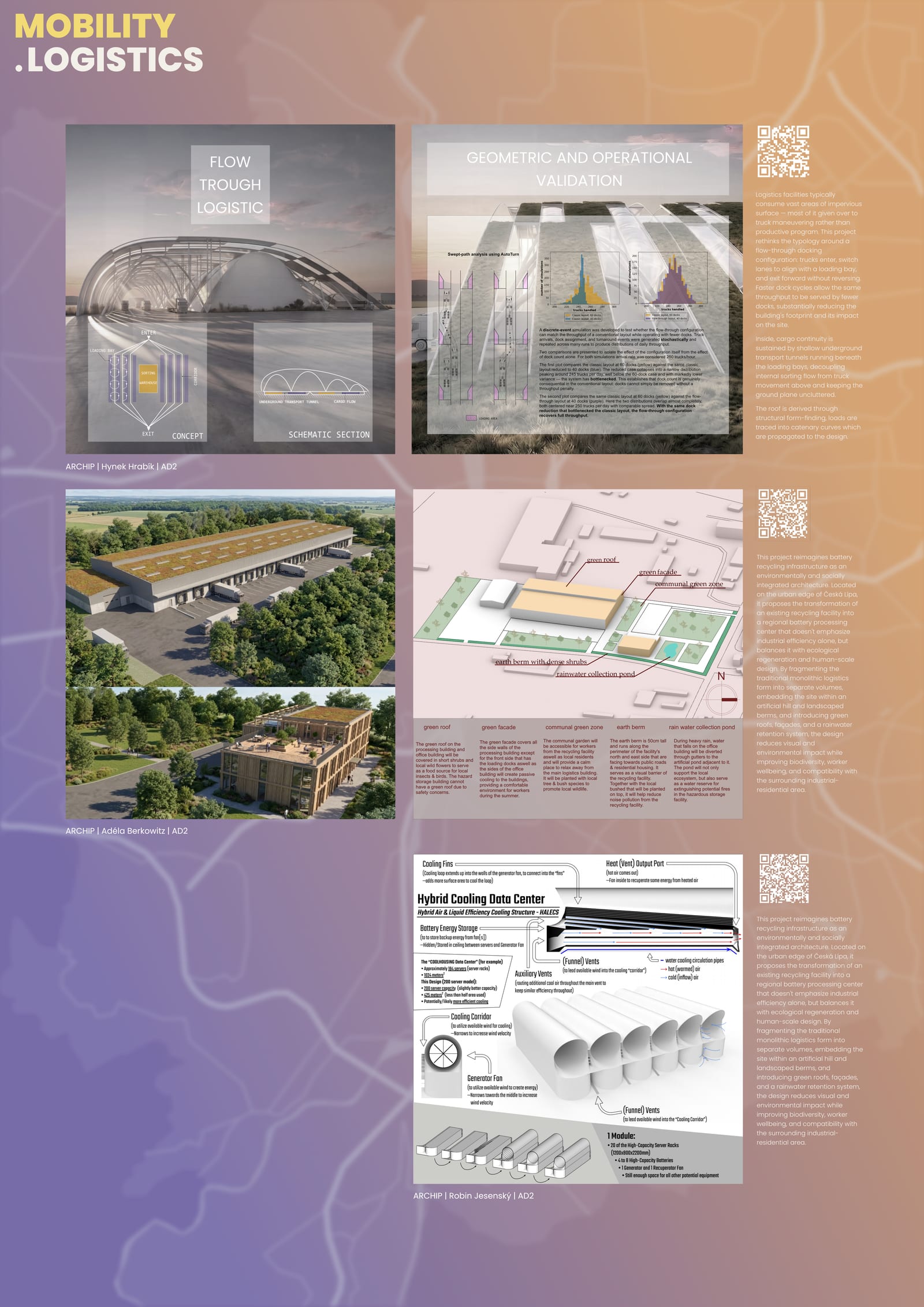
Group sheet, top to bottom: Hynek Hrabík (flow-through logistics), Adéla Berkovitz (battery recycling, Česká Lípa), Robin Jesenský (hybrid cooling data centre).
Key metrics
All values are as reported by the student; methods are documented in the linked case studies.
| Metric | Value | Source |
|---|---|---|
| Waste heat recovery | 225 GWh/year of heat emitted by the campus | Katrin Rybinskiy |
| Waste heat recovery | 11,500 MWh/year to the greenhouse (about 5% of the heat) | Katrin Rybinskiy |
| Rooftop PV generation | 2,520 MWh/year from a 14,652 m² roof | Katrin Rybinskiy |
| Rooftop PV generation | 1,590 MWh/year stored for resale, 860 for site maintenance, 70 for public EV charging | Katrin Rybinskiy |
| Waste heat recovery | 4,500 kW of heat in phase 1 (300 servers) → 17,250 kW in phase 2 | Julia Godard Lombard |
| Heat recovery radius | grows with each phase as the data-centre share rises, drawn on the city map | Julia Godard Lombard |
| Land take | about 425 m² for 200 servers vs about 1,024 m² for about 184 racks in an existing data centre | Robin Jesenský |
| Wind conditions | ≈9.82 m/s mean wind at 100 m height used as the siting criterion | Robin Jesenský |
The heat figures are hand estimates; even the phase 1 data centre in Prague produces far more heat than its own programmes need, which is the argument for exporting it to the district (Julia Godard Lombard). For context, the industry’s average power usage effectiveness fell from about 2.5 in 2007 to about 1.5 and has stalled there (Efficiency has hit a plateau at 1.5).
Trade-offs
- Roof for power against roof for nature. A fully PV-covered roof raises renewable generation but leaves no room for a green roof, so green and blue area must come from the ground (Katrin Rybinskiy); maximising PV also adds structural load (Julia Godard Lombard). See Solar energy against greenery.
- More servers against more neighbours. A higher data-centre share raises recoverable heat and the heat-recovery radius, but also energy and water use, and it pushes out the sauna and dry-food production that created most of the jobs (Julia Godard Lombard). See More servers against energy, water and jobs.
- Reuse against efficiency. Both urban projects reuse existing buildings to save carbon; experts caution that a less efficient data centre likely loses over its life, and that its embodied carbon sits mostly in the building services, not the shell (Don’t force the wrong second life on a building, In a data centre the embodied carbon is in the pipes). See Reuse against operational performance.
- Heat recovery does not remove cooling. Data centres must run through the hottest summer day, so full chiller capacity is needed regardless of how much heat is reused (Data centres are giant heaters). See More servers against energy, water and jobs.
- Wind against access. The windiest sites for passive cooling were protected or hard to reach for heavy construction vehicles (Robin Jesenský). See Site qualities against access.
Evidence gaps
- Calculation methods for the PV yield and total heat are not shown, and income from reused heat and surplus energy was not assessed (Katrin Rybinskiy).
- How much renewable energy can be produced on site was an open question for one project, and carbon, land use and biodiversity appear only as relative bars (Julia Godard Lombard).
- Cooling water, energy efficiency and the passive cooling itself were not quantified or simulated (Robin Jesenský).
- Heat recovery radius, Power usage effectiveness and Water consumption were used without a calculation tool, although tools that could compute Waste heat recovery were available (Evidence gaps).
- No project models how the heat would be delivered to a real district heating network — temperature, heat pump and pipe length — which experts name as the decisive factor (Brewing waste heat heats the public building).
Expert insights
- Waste heat is already an approval condition Expert Open for expert review — Jonathan Martins, Cloud in the city: data centres, urban development and implications
- Prague’s pipes are an asset — sell the heat Expert Open for expert review — Jonathan Martins, Cloud in the city: data centres, urban development and implications
- Dublin planned for data centre demand instead of reacting to it Expert Open for expert review — Jonathan Martins, Cloud in the city: data centres, urban development and implications
- A system with a data centre at its heart, not a standalone asset Expert Open for expert review — Jonathan Martins, Cloud in the city: data centres, urban development and implications
- 7,000 m² of farming on a Paris data centre roof Expert Open for expert review — Jonathan Martins, Cloud in the city: data centres, urban development and implications
- A swimming pool heated by servers in Milan Expert Open for expert review — Jonathan Martins, Cloud in the city: data centres, urban development and implications
- A warehouse heating a hospital Expert Open for expert review — Pavel Fojtík, From Model to Reality: Sustainability in Industrial Buildings
- Data centres are giant heaters Expert Open for expert review — Paul Astle, Net Zero That Holds Up: Whole-Life Carbon, Design Choices, and Delivery
- Efficiency has hit a plateau at 1.5 Expert Open for expert review — Jonathan Martins, Cloud in the city: data centres, urban development and implications
- Liquid cooling may quietly defuse the water fight Expert Open for expert review — Jonathan Martins, Cloud in the city: data centres, urban development and implications
- Brewing waste heat heats the public building Expert Open for expert review — Karel Goláň and František Novotný, Challenge the perception of industrial architecture as ‘boxing’
- Micro data centres – who takes the waste Expert Open for expert review — Jonathan Martins, Cloud in the city: data centres, urban development and implications
- The digital Fort Knox Expert Open for expert review — Jonathan Martins, Cloud in the city: data centres, urban development and implications
- Utah’s random giants are not the model Expert Open for expert review — Jonathan Martins, Cloud in the city: data centres, urban development and implications
Regulatory observations
- In parts of northern Europe, heat recovery into district heating is a routine design and planning consideration whenever a data centre is submitted for approval (Waste heat is already an approval condition); where current standards do not ask for it, the exchange depends on the goodwill of the developer.
- Sharing energy between buildings in a city is already allowed under Czech energy law; a Panattoni warehouse in Rotterdam shows the model, carrying far more PV than it needs and sharing energy with local hospitals (A warehouse heating a hospital).
- Dublin steered data centres into chosen parts of the city as part of its energy and land-use planning; the lecturer described urban planning as a tool that is badly underused in Europe (Dublin planned for data centre demand instead of reacting to it).
- Data centres count as an industrial use but are not yet tracked in the sector’s shared research data (Hyperscale data centres skip Czechia for lack of power), which makes planning for them harder.
Questions for practice
- Developers: Could a site be chosen for its distance to the heat network and its grid connection first, and for the price of land second?
- Designers: Which neighbours — homes, greenhouses, pools, public buildings — can take the heat at the temperature the data centre actually delivers, and how far can it travel?
- Municipalities: Could heat recovery and a heat-sales agreement with the district heating company be part of the planning conditions, as in northern Europe?
- Everyone: Who takes responsibility for the equipment and the heat supply when the servers become obsolete after a few years?
Connections
- Case studies: Katrin Rybinskiy, Julia Godard Lombard, Robin Jesenský
- Challenges addressed: Waste heat and cooling of data centres, High operational energy demand, Embodied carbon of new and demolished warehouses, Visual impact of logistics on neighbours
- Metrics: Waste heat recovery, Heat recovery radius, Rooftop PV generation, Power usage effectiveness, Water consumption, Mixed-use ratio, Land take, Wind conditions, Embodied carbon intensity
- Insights (tagged with the domain): 177 boreholes, 150 metres deep, 7,000 m² of farming on a Paris data centre roof, A swimming pool heated by servers in Milan, A system with a data centre at its heart, not a standalone asset, A warehouse heating a hospital, Amazon multi-storey – 60–70% self-supplied, Brewing waste heat heats the public building, Czech grid is the real siting constraint, Danish pit-storage heat pumps match warehouse scale, Data centres are giant heaters, Data centres now outbid logistics for land, power and capital, Dublin planned for data centre demand instead of reacting to it, Each IT generation makes the building hotter, Efficiency has hit a plateau at 1.5, Electrification is a system shift, not a vehicle shift, From 20,000 households to a country, Full automation would need power plants bigger than the logistics, Grid capacity becomes a planning constraint, Hyperscale data centres skip Czechia for lack of power, Industrial sheds as 4th-generation district heating nodes, Liquid cooling may quietly defuse the water fight, Micro data centres – who takes the waste, Oversize the wires now, Power and labour, not land, are the real constraints, Prague’s pipes are an asset — sell the heat, Renewables as price insulation, not just carbon, Self-generated power as a development advantage, Sell the warehouse as a power station, The digital Fort Knox, The plateau is why siting becomes the design lever, The power grievance is half right, Thirty-metre freezers are a heat source, Utah’s random giants are not the model, Waste heat is already an approval condition, Wind in Czechia is a mentality problem
- Ambitions (through its projects): Compact footprint, Good neighbour, Logistics as part of the city, Low energy and water demand, Mixed use and function stacking, Modular and prefabricated architecture, Reuse of existing buildings, Shared waste heat
Something wrong or missing? Suggest a correction